In an effort to increase the visibility of the National COSEE Network within target audiences, the National COSEE Office is working to establish an organized COSEE presence at various national science and education society conferences and meetings including:
Ocean Scientists - American Geophysical Union (AGU) and Ocean Sciences (AGU, ASLO, TOS)
Diversity (Students Underrepresented/Underserved in STEM Disciplines) - Society for Advancing Chicanos and Native Americans in Sciences (SACNAS)
Science Education - National Science Teachers Association (NSTA)
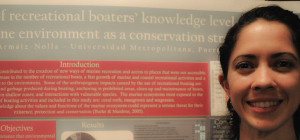
Posters and other conference presentation materials are displayed here.
In this contribution we present activities done with final year high school students introducing them to coastal engineering and marine renewables. These activities take place within a day and involve around 30 pupils from around the UK. The workshop includes: an introduction to marine renewables lecture, hands-on marine renewable prototype development and testing, a keynote lecture on coastal processes and structures, and an afternoon boat visit to the Plymouth Sound and the Plymouth breakwater.
Volunteer interpreters play an integral role in communicating ocean science to the public in informal science education settings, such as state parks, aquariums and science centers, and scientists are a valuable source of knowledge and information for training these interpreters. Evaluation data collected by COSEE Pacific Partnerships for the Oregon Coastal Master Naturalist Program highlights the value of engaging scientists as workshop instructors for interpretation audiences, and the challenges faced in attempting to effectively communicate science to those who communicate science with the public.
For Black, Latin American and Native American students, the largest leak in the STEM pipeline occurs between high school and college. We present the Lamont-Doherty Secondary School Field Research Program as a potential model for intervention by research institutions and departments that can (a) improve college attendance, (b) improve STEM recruitment and (c) invigorate teaching practices at this critical educational gateway.
Increasing the number and diversity of students who successfully pursue careers in Ocean Sciences is key to addressing the growing demand for professionals in our fields who genuinely understand and make a contribution to cutting edge research. Summer research programs for undergraduates play a critical role in this process by creating environments in which students can develop the strategies and professional skills necessary to pursue meaningful careers in various STEM fields and by supporting students as they “bridge” between undergraduate and graduate studies.
COSEE-West’s online workshops focus on bridging ocean science research and education and promoting collaborations among ocean scientists, K-12 teachers and informal educators. They provide a venue for scientists to share their research and expertise with educators, who reach an even broader audience of students and public. Educators question, give feedback, and share expertise in classroom application of science.
Ocean Networks Canada (ONC) Observatory, comprised of VENUS and NEPTUNE Canada cabled networks, supports transformative science in coastal and deep sea ecosystems. It enables interactive experiments focused on ocean health, energy resources, natural hazards, and marine conservation for international research collaborations.
Real-time data play an important role in science education by adding relevance to the learning experience, by enabling self-discovery and inquiry, and by providing opportunity for dialogue between students and researchers. Over the past decade, profiling floats (such as Argo) have proven to be excellent platforms for deployment of biogeochemical sensors.
Tapping into multimedia is a sensible way to broaden the impact of your science. But in a world awash with on air and online media, how do you produce content that both holds up and stands out?
Modeled after NSF’s Research Experiences for Undergraduates program, COSEE Florida’s Research Experience for Pre-Service Teachers (REPT) project is an educationally valuable capstone element within the Bachelor’s Degree in Middle Grades Science Education with a Concentration in Ocean Science at Indian River State College (IRSC). In summer 2011, junior and senior level science education majors conducted research with mentors from three local marine research organizations, produced a scientific poster and crafted an educational multi-media presentation.
In 2010-2011 we completed a rigorous field campaign to examine the impact of upwelled Modified Circumpolar Deep Water on the Ross Sea ecosystem. Fully integrated with this science plan was a comprehensive education program designed to introduce new audiences to the experience of Antarctic research and the AUV technology used.
New participatory courses in Marine Sciences are now a central component of the Rutgers undergraduate Marine Science curriculum. The courses use new datasets enabled by ocean observatories, in particular, the interactive exploratory capabilities of underwater gliders. The overall program is designed to increase repeated contact with students similar to the graduate experience.
COSEE NOW reviews their experience in using real-time data in this PowerPoint presentation and comments upon which tools are likely to become increasingly important to their lab in the coming years.
COSEE NOW is dedicated to supporting ocean scientists in successfully communicating the broader impacts (BI) of their research. We have created a suite of new online resources for scientists, which compliments and enhances our existing social networking portal that brings together researchers and educators from the ocean science community.
The Education and Public Engagement Implementing Organization (EPE IO) for the National Science Foundation’s Ocean Observatories Initiative (OOI) is developing tools for educators to bring real and near-real time data, images, and video of our oceans into both formal and informal learning environments.
The world we live in is increasingly characterized by data. In oceanography, the Ocean Observatories Initiative (OOI), the Integrated Ocean Observing System (IOOS) and other efforts are spurring advances in sensor technologies and cyberinfrastructure that are changing the way oceanographers conduct research and share their results with the world. As we look to train the next generation of scientists, it is imperative that students have the opportunity to develop the skills necessary to collect, analyze and understand data.
Rutgers University and Liberty Science Center partnered on the broader impacts of an NSF Antarctic Sciences Division funded mission. Ross Sea Connection, which ran from the summer of 2010 to May 2011, connected mission scientists with 25 middle- and high-school earth science teachers and students who were thousands of miles apart. The project’s evaluation was designed to determine the success in bringing together scientists and educators to improve science education.
From December 2010 through June 2011, Liberty Science Center offered a two-day ocean science program to 208 students and their teachers from 10 public high school in Newark, New Jersey. The program consisted of focused instruction and hands-on activities and labs related to the ocean's physical and chemical characteristics and how these affect biological systems.
This program included several data-oriented lessons developed under the Center for Ocean Science Education Excellence-Networked Ocean World (COSEE-NOW) and was intended to increase ocean literacy in students, enhance their ability to interpret and manipulate data, and raise awareness of how ocean scientists do their work.
To increase diversity in one influential science community, a consortium of public and private institutions created the Woods Hole Partnership Education Program, or PEP, in 2008. Aimed at college juniors and seniors with some course work in marine and/or environmental sciences, PEP is a four-week course and a six-to-eight-week individual research project under the guidance of a research mentor. Forty-seven students have participated to date. Investigators from the science institutions serve as course faculty and research mentors.
In collaboration with the Center for Ocean Sciences Education Excellence California (COSEE CA), scientists at Scripps Institution of Oceanography (Scripps) have worked with a group of three middle school science teachers to teach students how marine natural products research at Scripps connects and contributes to the clinical drug discovery process. The participating San Diego Unified School District 7th grade life science teachers routinely teach a unit on drug discovery to approximately 300 students each year, and enrich the instruction by providing students the opportunity to communicate face-to-face with marine scientists through an interactive videoconference.
The Controlled, Agile, and Novel Observing Network (CANON) team at MBARI is creating new ways to remotely assess biological ocean conditions and collect samples of microorganisms. This presentation covers the high level requirements, architecture, implementation overview and lessons learned in the CANON experiments.
A PowerPoint presentation by COSEE-TEK on Teacher Technology Experiences (TTEs), the goals of which are to improve educators’ technology content knowledge, heighten scientists’ awareness of the challenges of science education and outreach, and broaden the impacts of researchers' science and technology by web-based educational resources.
Fostering partnerships between scientists and pre-college classrooms is a win-win scenario for both sides! Developing experiences in authentic research not only impacts the teacher and her students, but also has the potential to change thinking in the community.
Maryland Sea Grant strives to provide students from underrepresented groups in marine science opportunities to participate in its NSF-supported Research Experiences for Undergraduates (REU) program in estuarine science. While women dominate the applicant/accepted student pool, we are testing different strategies to increase the number of students from underrepresented groups in our program.
Professional learning communities (PLCs) are one model for helping improve collaboration between scientists, educators and public audiences and hold inherent value for engaging scientists in educational and outreach programming. This session discusses evaluation findings from three different education and outreach programs in California and Oregon.
The COSEE network is driven by its goals of developing effective broader impacts of ocean science and integrating cutting-edge ocean research into educational programs and activities. This workshop was a first step at sharing best practices between two significant countries in a field (science education) that has not traditionally shared all its learning through peer-reviewed literature.