|
|
 |
|
|
|
|
|
11.14.2017
Speakers will address their path into the private sector, the nature of the work in their current position as well as the range of positions available in their field, and the skills and experiences that can best prepare a student interested in a similar career pathway.
MORE >>
|
|
|
10.20.2017
This webinar will review the range and evolution of skills necessary to prepare students, within the ocean sciences, for academic employment in the 21st century. Learn more about ocean technologies, ICT (big data), diverse engineering (renewable energy, aquaculture), social sciences (e.g. Coastal & Marine Spatial Planning), resource economics and their role in the academic forum.
MORE >>
|
|
09.28.2017
This webinar series is a follow-up to the workshop conducted during the 2016 AGU Fall Meeting exploring career pathways for geosciences students.
MORE >>
|
|
09.27.2016
This time of year IBP (Institute for Broadening Participation) tries to remind students of upcoming graduate fellowship and undergraduate scholarship deadlines. Many programs have application deadlines in the coming weeks and months!
MORE >>
|
|
09.13.2016
The first Global Ocean Science Education (GOSE) Workshop in June 2015 brought together ocean scientists and education professionals from 15 nations. Panels discussed ocean science education across the K-12 pipeline, undergraduate and graduate education, and public education. Working groups discussed the future of global ocean science education, opportunities and steps for building international collaborations, and establishing a global network of networks.
MORE >>
|
|
11.22.2015
Connecting students with STEM funding and opportunities, such as paid summer research, graduate fellowships, and graduate programs.
MORE >>
|
|
11.03.2015
Learn facts and stats on the water cycle from SodGod.
MORE >>
|
|
08.18.2015
Based on the recently released National Research Council report Taking Science to School: Learning and Teaching Science in Grades K-8, this book summarizes a rich body of findings from the learning sciences and builds detailed cases of science educators at work to make the implications of research clear, accessible, and stimulating for a broad range of science educators. This book is available in English and Spanish.
MORE >>
|
|
 02.27.2015
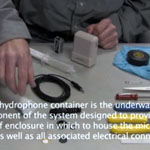
The COSEE-TEK DIY hydrophone project has evolved over the years with design improvements, refined methods, and increased collaboration with community colleges and the Marine Technology for Teachers and Students (MaTTS) program at University of Rhode Island.This 28 minute YouTube video describes all of the parts, tools and steps necessary to construct an affordable hydrophone (~$45) for use by teachers and students to explore underwater sounds. Click here to download the complimentary Material List and Fabrication Instructions (Version 4.0, Modified for MaTTS [6/25/2014]).
MORE >>
|
|
 08.11.2014
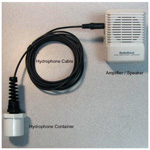
For the collaborative Acoustics Teacher Technology Experience (TTE) with American School for the Deaf (ASD), COSEE-TEK staff designed a new do-it-yourself hydrophone based upon the design by Vivas and Lopez presented in this manuscript entitled "Construction, calibration, and field test of a home-made, low-cost hydrophone system for cetacean acoustic research" (2014). This design is low-cost, effective and simpler than previous designs, using a piezo-electric element potted with epoxy in a simple housing to record the sound. The DIY hydrophone project has evolved with design improvements, refined methods, and increased collaboration with community colleges and the Marine Technology for Teachers and Students (MaTTS) program at University of Rhode Island.
MORE >>
|
|
07.02.2014
Students play a game that demonstrates the importance of primary production by Arctic Ocean ice algae and the use of isotopes to trace sources of nutrients in food webs. They also discuss the implications of shrinking Arctic sea ice as a result of climate change.
MORE >>
|
|
06.12.2014
A slide show with links to calculators and tips for low carbon living.
MORE >>
|
|
03.28.2014
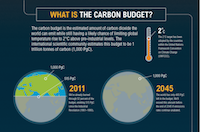
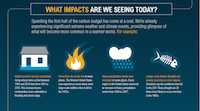
Infographic poster describing the Carbon Budget, developed by the World Resources Institute with data from a recent (2013) IPCC report.
MORE >>
|
|
 03.28.2014
Part 1 of 4 of an infographic poster depicting the global Carbon Budget developed by the World Resources Institute.
MORE >>
|
|
 03.28.2014
Part 2 of 4 of an infographic poster depicting the Global Carbon Budget developed by the World Resources Institute.
MORE >>
|
|
 03.28.2014
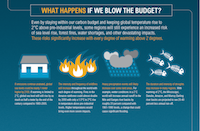
Part 3 of 4 of an infographic poster depicting the Global Carbon Budget developed by the World Resources Institute.
MORE >>
|
|
 03.28.2014
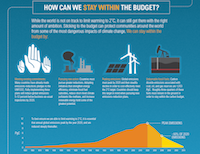
Part 4 of 4 of an infographic poster depicting the global Carbon Budget developed by the World Resources Institute.
MORE >>
|
|
03.13.2014
NASA/JPL are once again hosting Climate Day on Friday, April 11.
MORE >>
|
|
02.28.2014
This document contains the extracted Next Generation Science Standards which represent potential paths to introduce topics within ocean sciences.
MORE >>
|
|
02.22.2014
A new report, "Opportunities for Creating Lifelong Ocean Science Literacy", is now available. COSEE OCEAN sponsored an inquiry group to examine the current state of ocean science literacy, writ broadly, and to provide an expert perspective on how ocean literacy can be further developed and enhanced, especially through less-recognized channels such as opportunistic learning, the private and “third” sectors, and the enormously varied activities under the heading of “informal science education.” T
MORE >>
|
|
02.16.2014
COSEE-TEK strives to enhance ocean science and technology literacy with hands-on experiences for students and teachers of all ages in an effort to engage and recruit the next generation of STEM workforce. Over the past three years, the center has partnered with the Louis Stokes Alliance for Minority Participation (LSAMP) for an Ocean Science & Technology Challenge (OSTC) engaging a team of students and mentors in the design, building, and field testing of an ocean sensor or sampling device in Long Island Sound.
MORE >>
|
|
01.15.2014
The COSEE network has been successful at reaching its core mission of engaging scientists and educators to transform ocean sciences education for all. The network has achieved this by integrating the results of current scientific research into classrooms and informal education venues, giving thousands of scientists the opportunity to broaden the impacts of their research.
MORE >>
|
|
10.24.2013
Our COSEE partner in Florida is offering a new opportunity to support middle school science teachers through the Ocean 180 Video Challenge, bringing ocean science research into classrooms through film.
MORE >>
|
|
10.17.2013
COSEE-IE Student Ocean Film Contest Informational Flyer
MORE >>
|
|
10.17.2013
COSEE-IE Student Ocean Film Contest Submission Form
MORE >>
|
|
|
|
|
|
|
|
|
|